
Look up! The Annual Fall Migration is upon us. For this season’s nature spotlight, we take a look at one of Earth’s greatest spectacles as creatures big and small ride thermal lifts and shoreline winds, staging and streaming south. According to the Ontario Field Ornithologists, migration of winged things begins in mid‐August with most species peaking in September and October, and the migration gradually tapering off after mid‐November into December.
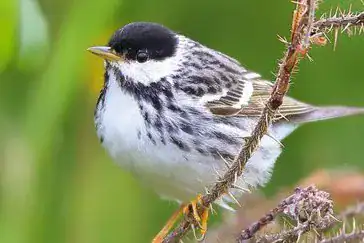
The Blackpoll Warbler (Setophaga striata), a small, olive-green songbird, weighing just 12 to 15 grams is a champion of long-distance flight, travelling up to 3,000 kilometres in a single flight! They rest and fuel up at Lynde Shores, Second March or Thickson Woods before launching across Lake Ontario. After another rest, these Warblers begin a non-stop journey over the Atlantic Ocean, all the way to South America, which seems unbelievable!
In mid-September, huge numbers of Ospreys, Northern Harriers, Sharp‐shinned Hawks, Broad‐winged Hawks, Merlins and American Kestrels surge south within the space of a week. Riding thermals on warm, sunny days, some of these birds of prey travel 7,000 kilometres to wintering grounds in the Amazon Basin – sounds nice! These birds take their time, soaring in flocks, called kettles, and glide along slowly.
You know Autumn has arrived in earnest when the skies are littered with turkey vultures heading south through Durham Region. Before their flight across the lake, the vultures roost together on trees in groups called venues, catch a last minute meal of carrion or roadkill, and take to the thermals, soaring with a minimum of energy expenditure.
Joining the flow of migrants south are the famous Monarch butterflies. Much has been written about these orange and black beauties, as they make a heroic journey south to a place called the Trans-Volcanic Mountains of central Mexico, a roughly 5,000 kilometre trek.
Lesser known is that these Monarch butterflies leaving Durham Region in September are the “super generation”, living up to 8 months (as opposed to 2 to 6 weeks for summer generations) just to make this one-way odyssey. Truly spectacular.
Finally (though there are countless many amazing birds and butterflies embarking on a long-distance marathon migration), we have Durham’s flying dragon, the Green Darner! Green Darner dragonflies migrate alongside birds and butterflies, using the same winds and weather fronts, and these legendary beings are truly amazing, heading south all the way to Texas, Florida, or Mexico. Like Monarch butterflies, Green Darners’ full migration takes multiple generations; the ones you see leaving Durham Region in September are the final northern generation, heading south to breed and lay eggs.
So look up, and you may just catch a glimpse of a river of wings this Autumn.
Photo obtained from https://extension.psu.edu/protected-species-in-pennsylvania-blackpoll-warbler